

In conversation with Deidre Taylor of the Stellenbosch Cabernet Collective, EMILE JOUBERT explores what makes Stellenbosch the perfect home for Cabernet Sauvignon.
Cabernet Sauvignon, the small-berried, big-tannin and immensely fruited red grape, achieved its status over two centuries as the world’s most planted and most celebrated variety by its ability to create wines of unrivalled structure, presence and authority. Quite simply, Cabernet Sauvignon is the most revered red grape responsible for making the widest diversity of great wines on planet Earth.
This reputation has its roots in the Bordeaux region of France, Cabernet Sauvignon’s ancestral home where it evolved as a crossing between the red Cabernet Franc and the white Sauvignon Blanc, both varieties at home in this famed part of south-western France. In the 19th century, when Europe and the rest of the world began taking a serious interest in the quality, diversity and places of origin of wine, Bordeaux established itself as the holy grail (Burgundy followed later).
In 1855, the wine cognoscenti of Bordeaux penned its quality classification – and the world sat up and took notice. Thus began the global pursuit of First Growth Bordeaux labels such as Haut-Brion, Château Lafite, Margaux and Latour, and scores of other wines from this region judged as having a grandiose stature.
The fact that the First Growth and many other Bordeaux wines all contain a component of the Cabernet Sauvignon grape had a profound influence on the succeeding vinous compilations of many other countries. If Cabernet Sauvignon drives a major part of the status, quality and success of Bordeaux, surely other wine-producing nations can benefit from rooting these Cabernet Sauvignon vines in their soils.
And so today, Cabernet Sauvignon is the basis of many a fine wine, from the Coonawarra Valley and Margaret River of Australia to Chile’s Maipo Valley and the Napa Valley in California. Making great Cabernet Sauvignon has done wonders for a wine country’s reputation and image; a land able to deliver fine Cabernet Sauvignon must, in general, be perceived to be a good wine country.
South Africa has been part of the global Cabernet Sauvignon conversation since the 1960s and ’70s, when estates were beginning to produce their own wines instead of selling their grapes and nondescript wines to corporate liquor behemoths and co-operative cellars. And although a few Cabernet Sauvignons from other Cape regions – notably Paarl – have attracted a glimpse of recognition, it is Stellenbosch that rules Cabernet Sauvignon’s roost.
I would go as far as to say that when prodded for advice from an international wine-lover wishing to discover the best of South Africa, my first tip is to look for the words ‘Cabernet Sauvignon’ and ‘Stellenbosch’ on the label. I can’t think of a better introduction to South African excellence and the country’s commitment to classic elegance in wine.
Deidre Taylor, chairperson of the Stellenbosch Cabernet Collective, a forward-thinking and proactive body of producers that promotes the diverse merits and charms of the region’s Cabernet Sauvignon, reckons the variety is as synonymous with Stellenbosch as are oak trees, gabled houses and coffee shops packed with philosophising academics.
“Cabernet Sauvignon is often the star player in some of the world’s most popular and celebrated wines, and the Cabernet Collective must ensure Stellenbosch is part of that universe,” says Deidre, who is also the marketing director of Meerlust Estate, a producer of one of the country’s best examples of Cabernet Sauvignon.
With about 8 750ha of Cabernet Sauvignon planted in South Africa, Stellenbosch is the region with the most acreage under this variety, coming in at 2 292ha. Stellenbosch farmers have been planting Cabernet Sauvignon commercially since the late 1950s, but the true growth of Cabernet plantings really developed throughout the 1980s and ’90s. With the Wine of Origin system coming into being in 1973, varieties and regions started appearing on labels of wines grown, made and bottled on the estate.
“With Stellenbosch producers breaking away from the co-operative system, and many taking the visionary approach of creating their own brands, producers began experimenting and evaluating which varieties worked well on their farms taking soil, site, climate, and so on into consideration. Cabernet Sauvignon was a variety that worked on many farms throughout the Stellenbosch area, with the bonus of the grape having a greater cachet at the premium end of the spectrum than a variety such as Cinsaut, which dominated the country’s red wine offering until 35 years ago.”
The reason for the success of Cabernet Sauvignon in Stellenbosch is the non-negotiable combination of geography and people.
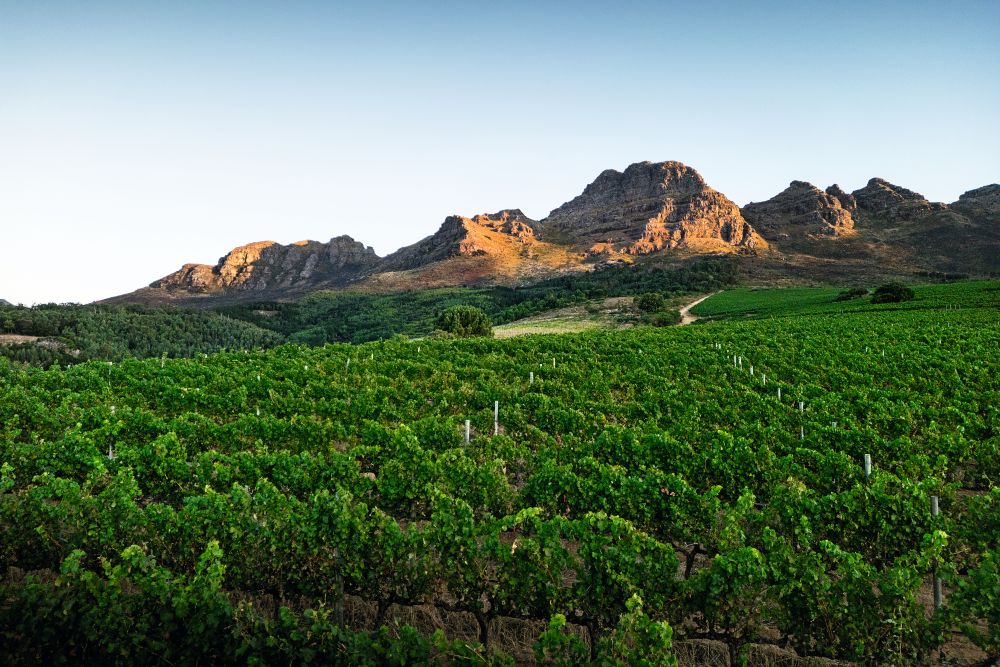
Geography-wise, Stellenbosch has the growing matter – granitic soils – and the climate and slopes Cabernet Sauvignon loves. Sufficient rainfall and plenty of sunlight hours – without excessive heat – in the warm Mediterranean climate enable Cabernet Sauvignon to ripen properly and produce its distinct medley of dark-fruit and fynbos flavours and a sunny minerality while still retaining acidity and freshness. The result is a regional wine offering of diversity harnessed by ripe tannins without being jammy or flabby.
Gorgeousness in a glass.
The other earthly aspect that enables the Stellenbosch region to deliver such startling variety in its Cabernet Sauvignon portfolio is the diversity of terroir parcels within its borders. From the low-lying flatlands of the Eerste River area in the south to the rain-drenched Jonkershoek Valley and the heady elevations of the Simonsberg and Helderberg, Stellenbosch is a multitude of distinctly different regions corralled within one official border.
Each varying territorial fingerprint of soil, vineyard aspect and climatic zone gives its grapes a visceral sense of place, allowing winemakers to create a magnificent treasure trove of Cabernet Sauvignon diversity under one label: Stellenbosch.
But to unlock this treasure trove, people are required. And in this regard, Stellenbosch is the place of wine pioneers whose legacy helped establish its status as one of the world’s leading Cabernet Sauvignon producers.
Abraham Izak Perold, he of Pinotage fame, in the 1920s was already encouraging Stellenbosch wine farmers to begin planting Cabernet Sauvignon, having recognised the noble allure of the variety and Stellenbosch’s suitability for these vineyards.
Manie Malan, former owner of Alto Estate on the Helderberg, worked shoulder-to-shoulder alongside Perold in establishing Cabernet Sauvignon on his farm. Initially using the variety in its famed Rouge red blend, Alto was a forerunner, bottling its maiden Cabernet Sauvignon estate wine in 1965.
Over by Simonsberg way, on Kanonkop Estate, the incomparable Jan Boland Coetzee recognised the potential of Cabernet Sauvignon on the farm where he became winemaker in 1969. He ripped out the Shiraz vines, planted Cabernet Sauvignon and in 1973 Kanonkop’s first estate-labelled wine was released: a Cabernet Sauvignon that heralded the beginning of one of South Africa’s most renowned wine properties and brands.
Nico Myburgh, seventh generation proprietor of Meerlust Estate, inherited a farm planted to Chenin Blanc, Sémillon and Cinsaut, the wines sold in bulk to one of the local corporates for bottling under innocuous brands devoid of provenance, heritage or a sense of place. Nico visited Bordeaux in the 1960s, drank the Cabernet Sauvignon-dominated wines of the Left Bank and decided that Meerlust’s future lay in Bordeaux-style wines made and bottled on the estate. He planted Cabernet Sauvignon, along with other Bordeaux cultivars.
And in 1975 the first Meerlust label appeared, the wine on which the estate hedged its bets: Cabernet Sauvignon.
As it had for Kanonkop, Cabernet Sauvignon introduced Meerlust to the world, and today the wines made from this variety on these properties ensure that their respective legends continue.
Thus, in the 1970s the wheel of Stellenbosch’s wine fortune was turning in the direction of Cabernet Sauvignon, largely thanks to the acclaim generated by these early pioneers: Alto, Meerlust and Kanonkop.
These revered marques live on, continuing to inspire today’s generation of modern winemakers who have picked up the Cabernet Sauvignon baton and are running with it. Under the banner of the Stellenbosch Cabernet Collective.
“Our approach as a collective is quite simple,” says Deidre. “We focus on One Region and One Variety, and often our promotion events and press tastings also focus on one single vintage. There’s something quite amazing about showcasing more than 30 wines, all from one region, one variety and one vintage. With so few variables to consider, it really helps to highlight the nuances of different sites in Stellenbosch, and different cellars’ interpretation of the variety.” She says the true aim is to create a larger global audience for Stellenbosch Cabernet Sauvignon.
“Many buyers of fine wine in South Africa are fully aware of how incredible Stellenbosch Cabernets are, but getting this message out to international markets is vital to growing the category,” she adds.
“We are competing against some of the best wines of the world, but we have the quality to be competitive. And with Stellenbosch Cabernet Sauvignon, we’re making fine wine at price points that are not nearly as eye-watering as the wines from Bordeaux and Napa. I think we’re well set up to provide an alternative to the world’s classic Cabernet Sauvignons.”
And thus, herewith a few:
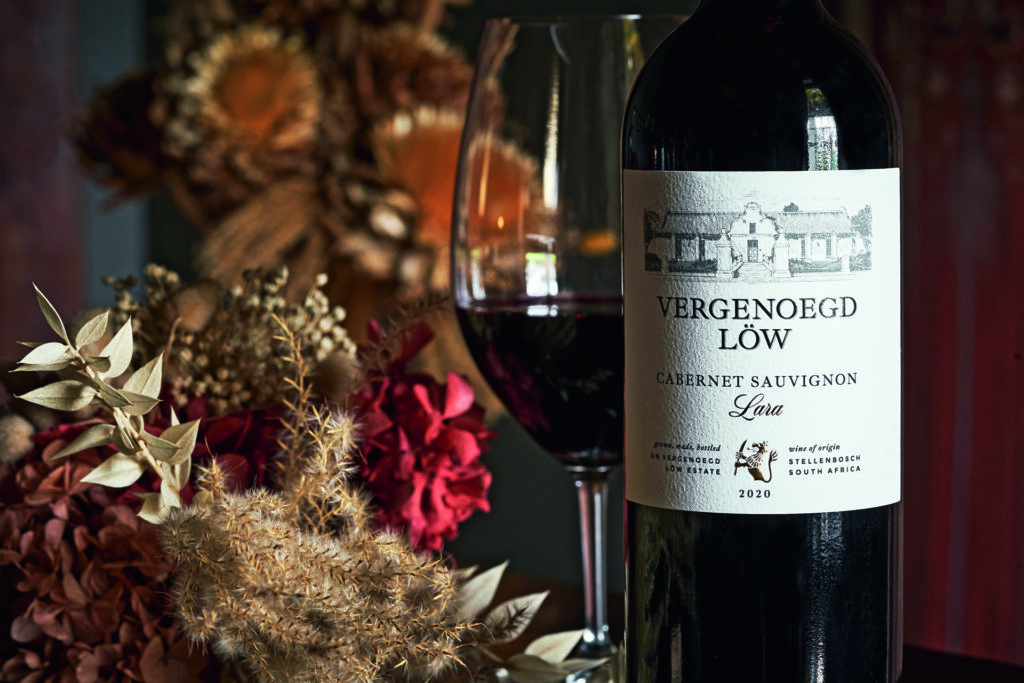
VERGENOEGD LÖW CABERNET SAUVIGNON
Vergenoegd Löw’s Cabernet Sauvignon is an instructive example of how Stellenbosch’s coastal plain can yield wines of classical bearing without recourse to altitude. Barely 3km from False Bay, the vineyards lie on sandy loam over clay and limestone, soils of marine ancestry that lend both poise and a certain chalky restraint.
Cooling south-easterly winds temper the Cape sun, allowing the Cabernet Sauvignon grapes to ripen steadily and evenly, an advantage in seasons where balance is the ultimate currency.
Viticulture here is rooted in a notably holistic philosophy. The estate’s famed Indian Runner ducks patrol the vineyards as natural pest managers, while livestock integration supports soil vitality and long-term vineyard health. Such practices are not decorative gestures but practical tools in maintaining an equilibrium in the vine that one senses in the measured, unforced fruit expression.
With a great history for producing Cabernet Sauvignon, the Vergenoegd Löw approach is classical. Grapes are cooled overnight before gentle handling in open fermenters. Regular punch-downs every few hours ensure thorough yet sympathetic extraction, while fermentation temperatures are held between 23°C and 26°C to preserve aromatic clarity.
Extended skin contact encourages colour stability and tannin polymerisation, after which the wine undergoes malolactic fermentation in barrel before maturing in second- to fourth-fill French oak, a judicious choice that supports structure without overwhelming varietal character. The wine is dense, packed with flavours of mulberry, cassis and Ribena, with hints of thyme, wild olive and cigar box that attach themselves to the alluring primal fruit.
UVA MIRA THE MIRA CABERNET SAUVIGNON
Where eagles dare to fly, high up on the Helderberg, lies Uva Mira, a winery of diversity and consistent excellence. The Mira Cabernet Sauvignon is, along with the cellar’s Chardonnay, for me the top Uva Mira offering, bringing together a veritable Cape grape with the winery’s style of cool, poised elegance.
Planted 300m–400m above sea level just 9km from False Bay, the vines draw salinity from the sea and granite grit from the earth: an unmistakable Cape signature.
Deep ruby in the glass, on the nose the wine is perfumed and refined: wild jasmine florals, savoury black olive and a sweet-earth lift cut with deep salinity and the faintest whisper of eucalyptus. It’s brooding yet elegant, like the Helderberg itself on a cool autumn evening.
The palate delivers exactly what the nose promises: bright red berries laced with subtle eucalyptus, then a juicy rush of red and blackcurrant, maraschino cherry and a graphite edge that keeps things thrilling. Creamy texture meets powdery, well-balanced tannins after 18 months in French oak (55% new).
At 13.5% alcohol it’s no blockbuster, but that’s the point – this is Cabernet with South African soul: approachable, harmonious and built for pleasure rather than posturing.
KLEINE ZALZE VINEYARD SELECTION CABERNET SAUVIGNON
Now owned by French wine company AdVini, Kleine Zalze can safely say that the provenance of its fruit from the region covered by the Stellenbosch Cabernet Collective has played a major role in its critical and commercial success.
The Vineyard Selection Cabernet Sauvignon is made from grapes sourced from various Stellenbosch vineyards, each a selected building block for the crafting of a stunning wine.
The emphasis is on vineyards set on ferricrete-rich (‘koffieklip’) soils that have long proved a natural ally to Cabernet Sauvignon. Fermentation in both stainless steel and open-top fermenters, with a thoughtful regime of punch-downs and pump-overs, yields tannins that are firm yet not austere and rigidly limiting. Twenty months in French oak (a judicious 35% new) adds polish and poise, depth and complexity – French oak being the universal yin to Cabernet’s yang.
And the wine is splendid. Aromatically, there is a distinctly Cape herbal lift – bay leaf and dried fynbos – before darker notes of blackcurrant and maraschino cherry emerge.
The palate is linear and well-proportioned, the fruit held neatly within a framework of fine, graphite-edged tannins. Oak sits comfortably in the background, lending a discreet cedary nuance rather than dominating.
Still youthful, the wine is instantly accessible but has the structure to reward patience. Speaking clearly of its Stellenbosch origins, it should evolve attractively over the next decade.
MURATIE MARTIN MELCK CABERNET SAUVIGNON
Muratie Cabernet Sauvignon is one of those wines that reminds you why Stellenbosch, and more specifically the Simonsberg, remains South Africa’s most convincing argument for Cabernet Sauvignon as a world-class proposition.
This example, drawn from three north-west-facing blocks planted in the 1990s at 260m above sea level, shows the quiet confidence that comes only from mature vineyards and a refusal to over-complicate matters in the cellar.
Hand-picked fruit, a measured cold soak and maturation in a modest 10% new French oak for 18 months provide structure without swagger, allowing the vineyard’s voice and Muratie’s cultural ethos to carry the conversation.
On the nose, it is unapologetically Simonsberg: black cherries and cassis first, followed by darker suggestions of plum skin, cedar shavings and that faintly resinous, pine-needle lift one associates with the Simonsberg’s slopes.
There is a whiff of something earthy too, not rustic but rooted, as though the wine has walked through fynbos before presenting itself at the table.
The palate is where Muratie’s traditional instincts show their merit. This is not a glossy, sweetly fruited Cabernet chasing applause. Instead, it offers restraint, a pleasing firmness of tannin and a line of acidity that keeps everything marching in step.
The fruit is concentrated but never blowsy, framed neatly by spice and graphite rather than overwhelmed by oak. What I particularly admire is the sense of proportion. Opulence is hinted at, just so, but polish and refinement win the day.
ALTO ESTATE CABERNET SAUVIGNON
Alto has long occupied a reassuring place in the South African Cabernet firmament and today still serves as a timely reminder of why the estate remains such a dependable standard-bearer for Helderberg reds. There is something deeply comforting about opening an Alto Cabernet Sauvignon; one senses continuity, discipline and a clear fidelity to place – virtues not always fashionable, but invariably rewarding.
The visual heart of Alto Cabernet Sauvignon shows a dense yet limpid garnet core. Aromatically, it is immediately engaging without undue flamboyance.
Classic Cabernet Sauvignon notes of damson and black plum are joined by hints of dried herbs, pencil shavings and a subtle earthiness that speaks eloquently of Stellenbosch’s iron-rich soils.
On the palate, the structure remains impressively intact. The fruit sits firmly at the centre along with a lip-smacking hint of savoury, yet it is the tannin profile that commands attention: fine-grained, persistent and seamlessly integrated after its time in French oak. The oak itself is judicious rather than declarative, lending shape and quiet spice rather than dominating.
What distinguishes this wine most clearly is its sense of balance. Power is present, certainly – the Helderberg seldom produces shrinking violets – but it is channelled with restraint and clarity.
AVONTUUR THE WEST PEAK CABERNET SAUVIGNON
This is a great wine, a telling sign that this historic Helderberg property has found a new vinous confidence under the stewardship of liquor company DGB. Once better known for its horses than its grapes, the estate is now firmly placing wine at the centre of its ambitions, and this Cabernet Sauvignon makes a persuasive argument for that shift.
Sourced from granite-rich Helderberg slopes shaped by maritime breezes from False Bay, the fruit reflects meticulous vineyard work: leaf-thinning to ensure even ripening, green harvesting to concentrate flavour, and rigorous bunch selection so that only pristine grapes reach the cellar.
And in that cellar the same fastidious attention continues. Berries are sorted before undergoing fermentation in stainless steel tanks over roughly two weeks, with regular pump-overs to extract colour and tannin while preserving fruit clarity.
The young wine is then transferred to 300L French oak barrels – 34% new, with the remainder second- and third-fill – where it matures for 16 to 18 months. This measured oak regime lends layered and integrated complexity rather than wood dominance, allowing the varietal character to remain firmly in the foreground. A light filtration before bottling ensures clarity without stripping texture, and further bottle ageing enhances integration.
In the glass, a deep garnet hue introduces aromas of blackcurrant, dark cherry and blueberry, brightened by a flicker of redcurrant. The palate is composed and purposeful: lush black fruit framed by vibrant acidity and fine, chalky tannins.
Notes of cedar, graphite and cigar box speak eloquently of Helderberg pedigree, while hints of dark chocolate and espresso emerge on a long, tapering finish. V