

On a Karoo hillside just north of Graaff-Reinet*, a chance discovery revealed a world 250 million years old. Today, that legacy lives on at Karoo Origins – The Fossil Centre, where the story of life, extinction and survival is written in stone, writes IGNA SCHNEIDER.
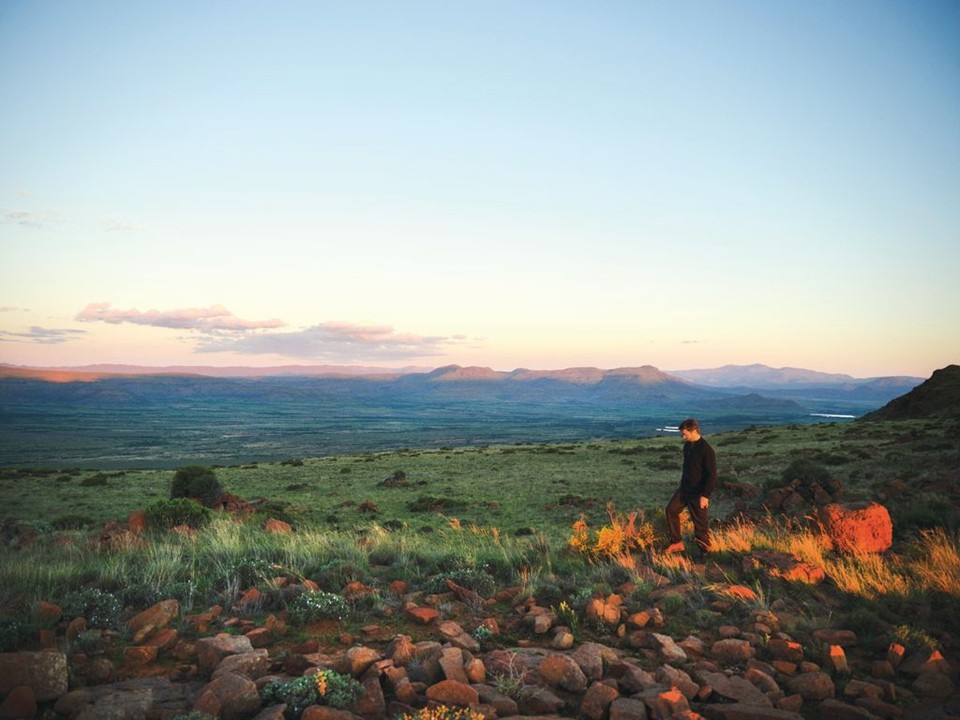
From a mudstone koppie just north of Graaff-Reinet, the Karoo opens out in vast flatlands beneath the Sneeuberg. Here, on the farm Wellwood, anker-karoobossies cling to the soil, their dust-grey leaves blending with the earth. Underfoot, slabs of weathered stone lie scattered across the veld.
At first glance the landscape feels sparse, almost empty.
Yet 250 million years ago the plains teemed with life. Rivers meandered through forests of Glossopteris and spread across wide floodplains. Herds of tusked dicynodonts crowded muddy waterholes, heads down, beaks working steadily through ferns.
Something moved in the reeds. A gorgonopsian, sabre-toothed and deadly, slipped through the shallows. Claws churned the mud. A rush – and it was over.
Then the floodwaters came, laying down sheets of silt across the plain. Mud closed over bone. Time passed. And the Karoo fell quiet again.
Prof. Bruce Rubidge grew up on this farm. The Rubidge family has been farming at Wellwood since 1838, building one of the country’s oldest merino studs.
“I was one of those lucky okes who was born into palaeontology,” he smiles. “Fossils were always in my blood.”
The story began here on Wellwood long before he was born.
In April 1934 his grandfather, Sidney Rubidge, was at home on the farm when his 10-year-old daughter Peggy returned from boarding school in Graaff-Reinet with a question: “Daddy, what are fossils and where do you find them?” Sidney admitted he didn’t really know.
Bruce continues: “Grandpa said, ‘It’s something to do with bone embedded in rock. Let’s go for a picnic and see if we can find one.’” Out on a mudstone koppie Peggy noticed something unusual in the rock. “Grandpa started knocking away with a hammer and chisel and eventually a thing that looked like the skull of a horse started appearing.”
Unsure what he had uncovered, Sidney wrote to Dr Robert Broom at the Transvaal Museum. When the renowned palaeontologist rushed to the farm to examine the fossil, the scale of the discovery became clear.
“Broom told him it was 250 million years old. That blew my grandfather’s mind.”
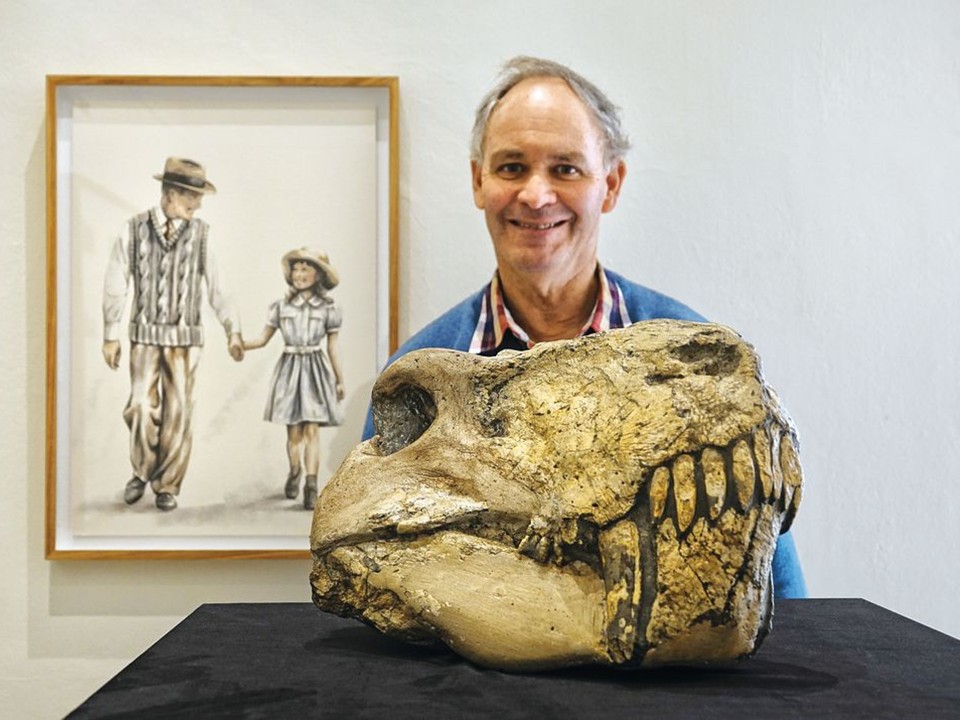
The fossil turned out to be the complete skull of a gorgonopsian, a large, flesh-eating, mammal-like reptile that roamed the Karoo in the Permian period.
It lived long before the first dinosaurs appeared, at the time when Graaff-Reinet was at the centre of the vast supercontinent Pangaea. And, most significantly, it belonged to the therapsid family, which were distant ancestors of mammals.
Broom named the new species Dinogorgon rubidgei, honouring the man who had first chipped it from the rock.
Having a species named after him did not impress the farmer. What did impress him was its age.
“Broom asked him to present it to the Transvaal Museum, but Grandpa said, “No, if it’s been on this farm for over 200 million years, I’m sure it doesn’t want to leave now.”
The discovery marked the beginning of what would become the Rubidge Collection, one of the most significant fossil collections in the world. It would ignite a wave of scientific interest and help place South Africa at the forefront of Permian fossil research.
Encouraged by Broom, who had a keen interest in the origin of mammals, Sidney Rubidge began searching the surrounding Karoo for more fossils. What had started as curiosity turned into a serious pursuit.
Over the next decade he collected specimens from farms and koppies across a wide swathe of the central Karoo, often working with local fossil hunters who knew the landscape intimately. Among them was a Nieu-Bethesda road engineer, Croonie Kitching, and his son James, who later became one of the Karoo’s most accomplished palaeontologists.
“As my grandfather was a pioneer in the field of Karoo palaeontology, many of the fossils he was finding turned out to be new species,” Bruce says.
By the mid-20th century, the purpose-built glass cupboards on Wellwood held hundreds of fossils. Each one was meticulously recorded and labelled by Bruce’s parents, Richard and Pam Rubidge, and neatly laid out on red felt.
“I grew up on the farm with my grandfather’s fossils thinking that every family had a collection like ours,” Bruce chuckles.

As a little boy of three, he once picked up a piece of concrete and proudly cycled with it to his grandfather’s house, convinced he had discovered a fossil.
“Grandpa said, ‘That’s a very nice fossil, thank you,’” Bruce recalls. A few days later Sidney handed the ‘fossil’ back to him. He had quietly carved eyes, nostrils and teeth into the lump of concrete. That sparked Bruce’s curiosity, and two years later the five-year-old found his first real fossil on the farm: a gorgonopsian, just like his grandpa’s.
In time, that childhood fascination would lead Bruce into palaeontology. He spent three decades at the University of the Witwatersrand, where he headed the Evolutionary Studies Institute. He became a Distinguished Professor and an internationally recognised authority on the ancient animals preserved in the rocks of the Karoo Basin.
In 2020, Bruce and his wife Marina returned to Graaff-Reinet to realise a life-long dream: to bring the Rubidge fossils out of the cupboards on Wellwood and into a space where their story could be shared and interpreted.
Through generous sponsorship, a historic building was bought in the heart of Graaff-Reinet, renovated and custom-fitted to house the collection. Last year, after 91 years of curation by four successive generations of Rubidge farmers, the entire fossil collection was moved to town.
Today the collection forms the heart of Karoo Origins – The Fossil Centre, a dynamic space that is part museum and education centre and part research hub. Academically linked to Wits, the centre also serves as a field station for local and international palaeontologists working in the Karoo.
“I could have given the collection to a museum or a university,” Bruce says. “But there it would have been swallowed up by much larger collections. Here, people can experience the fossils where they were actually found and that has greater significance.”

The story begins the moment you walk through the door.
On a pedestal near the entrance is the skull that started it all: Sidney Rubidge’s gorgonopsian, the fossil Peggy spotted on a picnic in 1934. Around it the story unfolds in fragments. There are photographs of Wellwood, copies of Sidney’s letters, and correspondence from the great palaeontologist Robert Broom, whose excitement about the discovery placed the Karoo on the scientific map.
From the family story, the view expands.
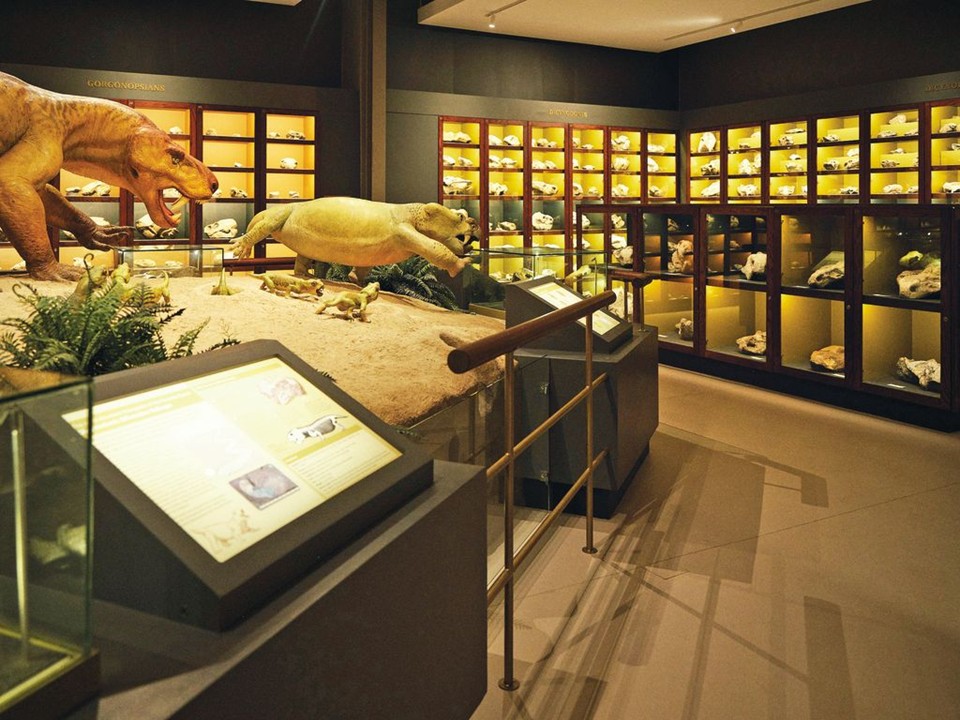
Glass cases line the walls, each carefully lit, as if in a portrait gallery. Inside them are rows of therapsid skulls, more than 850 in total – the strange faces of animals that once dominated the Karoo.
Seen together, evolution unfolds. Some skulls are heavy and reptilian; others show the subtle progression in bone, teeth and jaw that would eventually lead toward mammals.
Among them are 107 holotypes, the original fossils used by scientists to define new species.
“Museums usually lock holotypes away,” Bruce says. “But I wanted people to see the whole Rubidge collection, to understand just how many animals once lived here.
“In the rocks of the Karoo there are 247 different species of animals,” he explains. “My grandfather was responsible for finding 107 of these.”
Around the corner, the skulls are brought vividly back to life.
A six-minute looping animation settles on a Permian waterhole. Life-sized therapsids, anatomically exact, enter, hesitate, drink. A gorgonopsian moves into view, its scale precise, its movements convincing. Visitors watch in silence as the animals come and go.
In the next room, the world begins to unravel.
A section titled ‘The Great Dying’ traces the greatest mass extinction in the history of the earth, 252 million years ago. Massive volcanic eruptions in what is now Siberia drove greenhouse gases into the atmosphere. Temperatures rose, oceans warmed and ecosystems collapsed. The catastrophe wiped out 90% of species. A small lineage of therapsids survived and would eventually give rise to mammals.

“The Karoo fossils show how life changed before and after this event,” says Bruce. “Lootsberg Pass, just north of Graaff-Reinet, preserves one of the most complete records in the world of this extinction. Scientists from all over the world come here to study it. We’re still learning more about the extinction and the characteristics of those that survived.”
The exhibition then turns to the present. Modern humans appear as a late arrival in the sequence of life. The focus shifts to the consequences of our actions – a new wave of extinction, now unfolding across the planet and driven by human activity.
“What happened at the end of the Permian was driven by massive environmental change,” Bruce says. “The difference now is that there are no volcanic eruptions. It is us. We are changing the system.”
The story told here is not only about fossils. It is about our place in the long history of life on earth.
Outside, the Karoo lies quiet. Beneath the surface, the record continues to be laid down, slowly, over time. V