

No car better represents Mercedes-Benz’s 140-year journey through motoring than its hugely successful GLC. Supremely comfortable, capable on all surfaces and, above all, the definition of luxurious. PETER FROST set off through the Karoo in the latest GLC to find stories of the marque’s legacy and impact down the years.
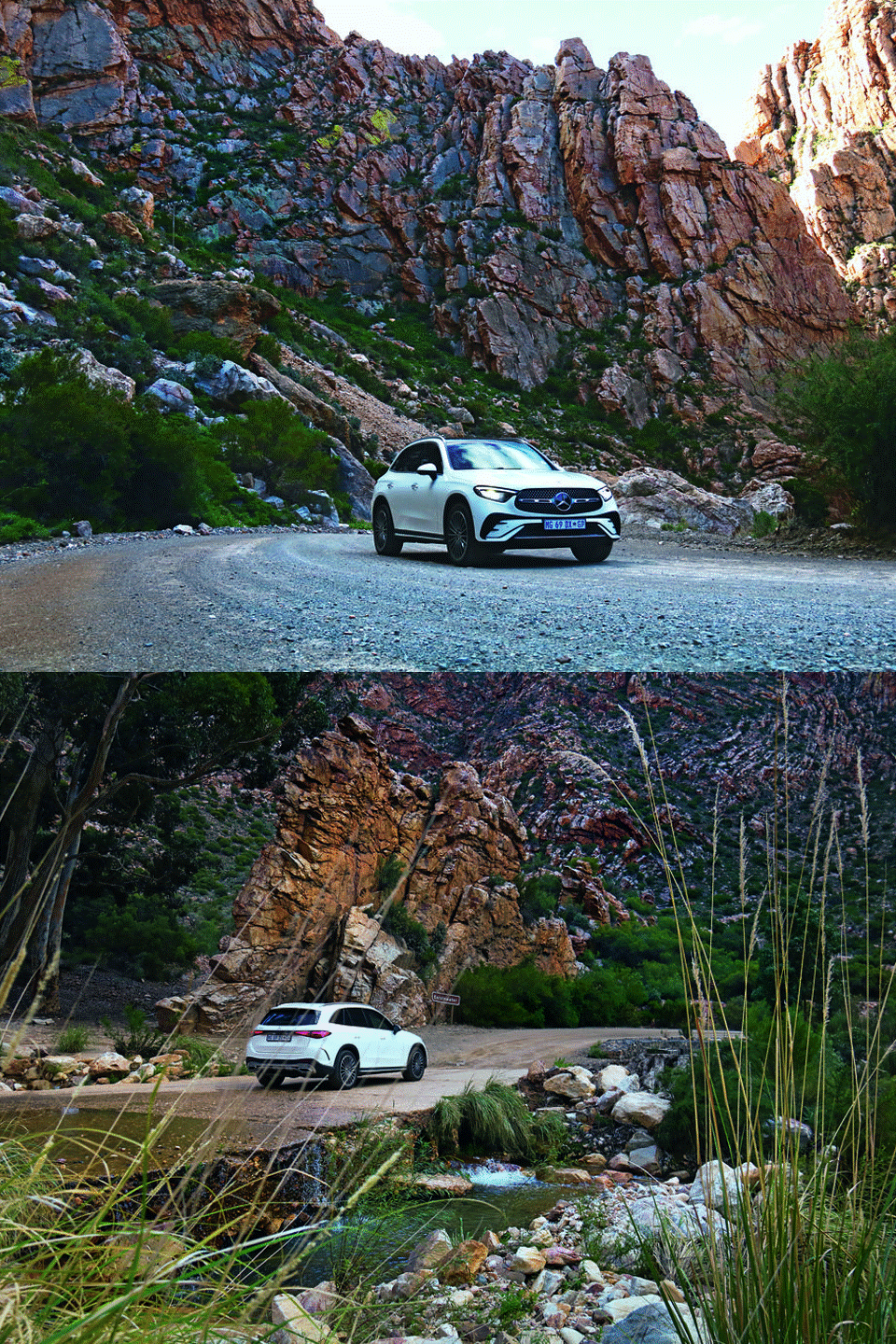
HISTORIAN AND VETERAN JOURNALIST Neill Hurford is not a man given to hyperbole. Taciturn, you’d suggest. Except when it comes to his 1975 450 SLC. His eyes light up as he talks about their life together. Friedrich Geiger’s exquisite two-door listens quietly alongside.
“When I’m asked why it’s so addictive, I can only say that its sheer delight is in the exaggeration of its crazy profile, the roar of its exhaust, the view down its ridiculously long nose and the feigned indifference of the glances it gets. Nothing much happens when you drive your 450, although it still goes like the clappers if you want it to. But generally, just sitting in the uncharacteristically comfortable driving seat, grasping the steering wheel that would be at home on a large yacht, and thundering down the main road of my Karoo dorp, annoying the locals, is enough excitement for anyone.”
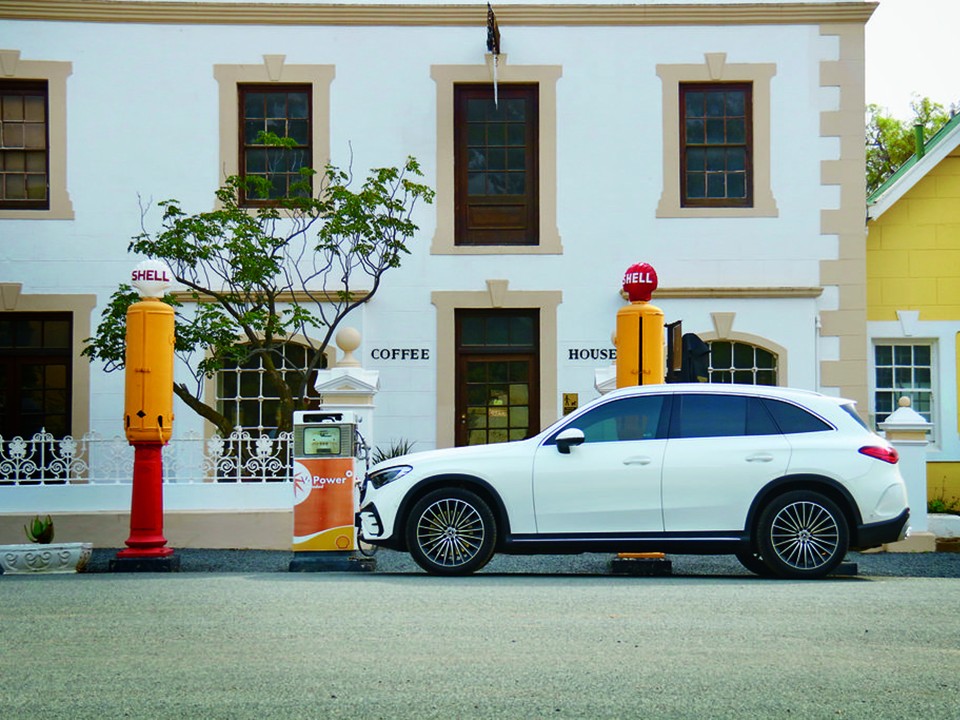
The Karoo dorp is Prince Albert, final destination of a trip that has taken the latest GLC 300d down dirt roads, up passes, across ancient landscapes. It was the collector of stories, gathered to celebrate the marque’s 140-year anniversary. Tales of cars that have become part of folklore as much as family. The soul of a community, reminders of heritage, heartache and triumphs.
But that’s getting ahead of ourselves. First the GLC 300d, arguably the most complete of contemporary Mercedes-Benz cars and certainly the most successful. The 300d features the celebrated 2L turbocharged diesel engine, a unit peerless in its manifest abilities. Consider: a 0–100kph time of 6.3 seconds, yet it can manage 5.5L/100km. And it does all this in near silence, easily the quietest diesel car on the market. Add a 48V mild hybrid system that allows for a stop-start/coasting system that is equally seamless, and you have the makings of a legend.
The 4Matic all-wheel drive is the cherry on the top, an electronically adjustable system ideal for Karoo dirt roads. Wet Karoo dirt roads.
Leaving Cape Town on a weekend that saw the weather gods break four months of near drought, there was no drama, even as we swapped N1 chaos for backroad sludge fest.
Aerodynamics are everything, said Adrian Newey, and the GLC’s teardrop shape underlined his point. Neither side winds nor cold-front gales could knock the car off its course. And in the mud, the masterful traction control and electronic suspension system worked a treat.
Select the Off-Road setting from the Dynamic Select digital display and all manner of useful things happen: the system optimises power distribution to the wheels with the most grip, it holds lower gears for longer and there’s the Transparent Bonnet, accessed through the camera system on the 12-inch centre console screen. It enables you to ‘see’ under the front of the car as you crawl across rocky terrain or through water.
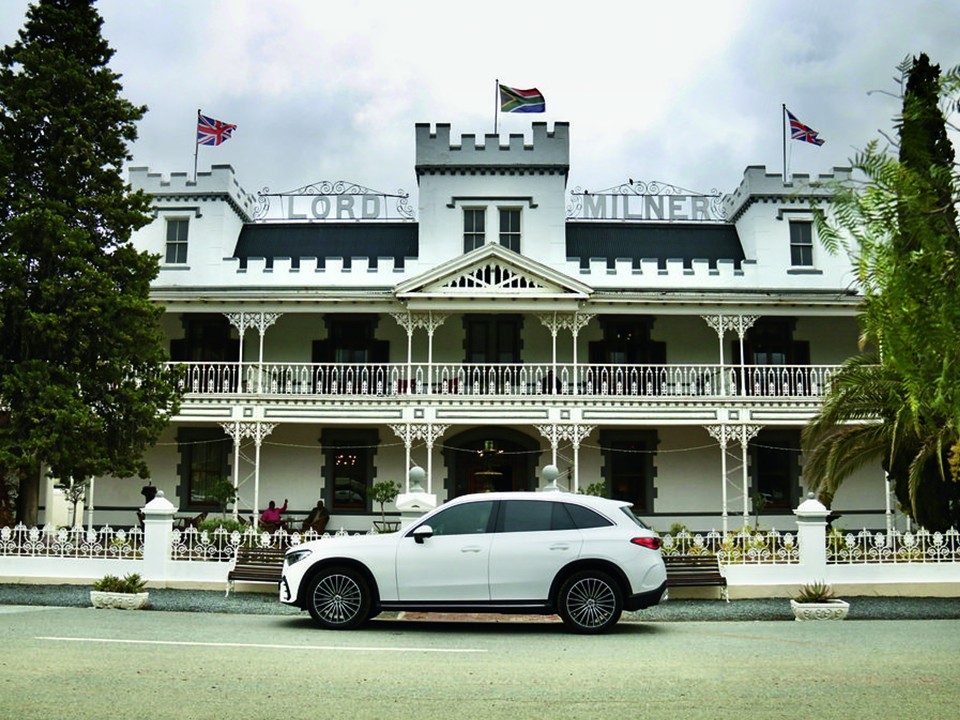
By the time Prince Albert came into view – far too soon – the temperature had dropped to 7°C and the shock after the warm, bespoke, ultra-comfy interior was a rude awakening. The plan was to do the insane: quickly nip up the Swartberg Pass before checking in with the good Mercedes’ folk of the dorp.
Insane turned out to be right. Not because the GLC, which has astonishing hidden talents, couldn’t manage Bain’s flagship pass – it can, and has, but that’s another story – but because it was closed after a torrential downpour. Access was possible only as far as Eerste River in the lower canyon, where at least we got to test the GLC’s wading abilities (most excellent) and listen for warring baboons in the far-off kloofs.
And so a return to the stories. Neill’s 450 SLC is an Oudtshoorn car, once a Cape Town car, with less provenance than a journalist would probably like. “I hit a kudu recently,” he remembers when I ask of motoring stories. “But not in the Merc.” Given the 450 SLC’s patrician bonnet, he’d probably have been much better off than in his bakkie. Driver survived. Bakkie and kudu did not. Down the road, the local solar-panel salesman-cum-Eskom worker gets around in an end-of-life 230 that has seen more than any car frankly deserves. He bought it from the water diviner in town who, as an elderly chap, preferred to drive it across fields to get to his appointments rather than walk.
The bringer of good news was a much-loved feature in town and on the farms; its presence suggested abundance. The same might be said of the current owner, bringing solar relief to an overstretched grid, although the 230’s days look all but over. Still, never underestimate a classic Merc – there’s usually more life there than seems possible.
Two days later, back on the road, en route through the Langeberg, the GLC consumed distance with remarkable ease. If anything represents how far we’ve come in 140 years of motoring, it’s how easy distance travelling has become.
Chopin on the five-speaker sound system, 20-inch Michelin low rolling resistance tyres underfoot, eerie silence at the national limit, stable, commanding sense of dynamic power – it’s light years away from the stresses of yesteryear motoring. Fold in the quintessential Mercedes-Benz experience, and luxury travel these days means time alone in a rarefied atmosphere through
an empty landscape. The very definition of exceptional.
Mercedes-Benz Innovations
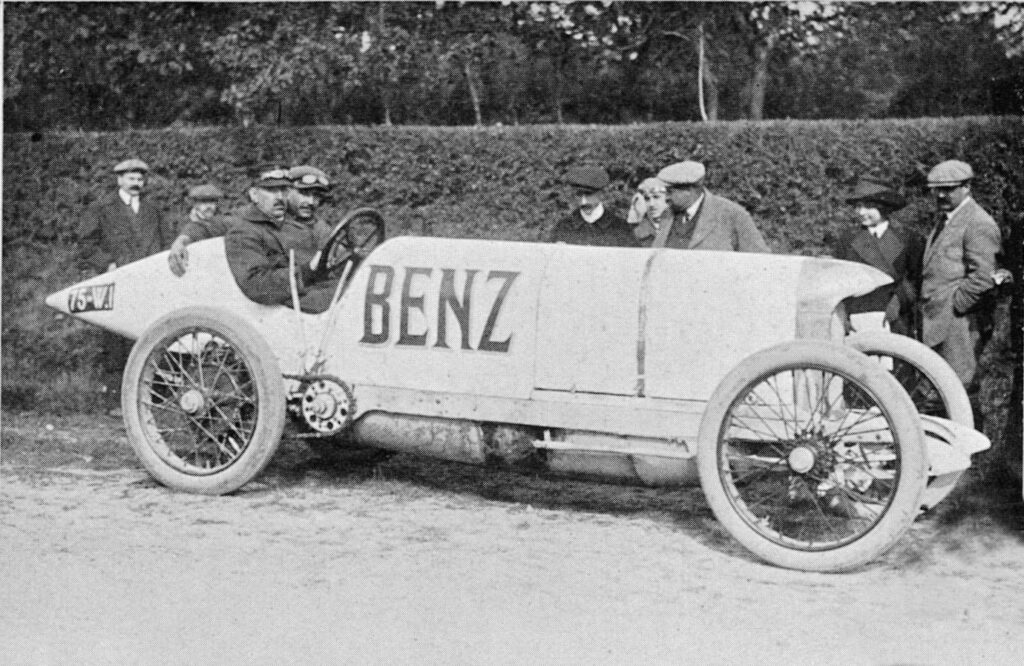
1886: THE INTERNAL COMBUSTION CAR Carl Benz’s single-cylinder Motorwagen was the first vehicle designed from the ground up to be powered by an internal combustion engine.
1900: THE HONEYCOMB RADIATOR Wilhelm Maybach’s honeycomb radiator invention for the Mercedes 35 PS effectively freed motorists from having to carry vast quantities of water on a trip.
1936: DIESEL CARS The Mercedes-Benz 260D brought durability and fuel efficiency to passenger cars. Diesel had only been used for truck and ship engines until then.
1951: THE CRUMPLE ZONE Béla Barényi’s idea that a car should absorb impact rather than simply endure it, changed safety forever. The Mercedes-Benz engineer’s design was first applied to the 1959 W111 Fintail.
1978: ANTI-LOCK BRAKING The 1978 S-Class featured a digital system monitoring wheel speed and rapidly pulsed the brakes to prevent wheel lock-up, allowing drivers to maintain steering control during emergency stops.
1982: MULTI-LINK INDEPENDENT REAR SUSPENSION Five independent, carefully tuned arms per rear wheel precisely controlled wheel movement in all directions, dramatically improving stability and braking. It was first used on the compact 190 and quickly became the industry standard.
2026: AXIAL-FLUX ELECTRIC MOTORS IN SERIES PRODUCTION Unlike the conventional radial-flux motors used in almost all current EVs, axial-flux motors offer a significantly higher power density and massive torque in a much lighter, flatter package.