

Marlene Dumas rose to the occasion when she received a historic invitation to create a new work for permanent installation in the Louvre in Paris. Marlene van Niekerk takes stock of this achievement.
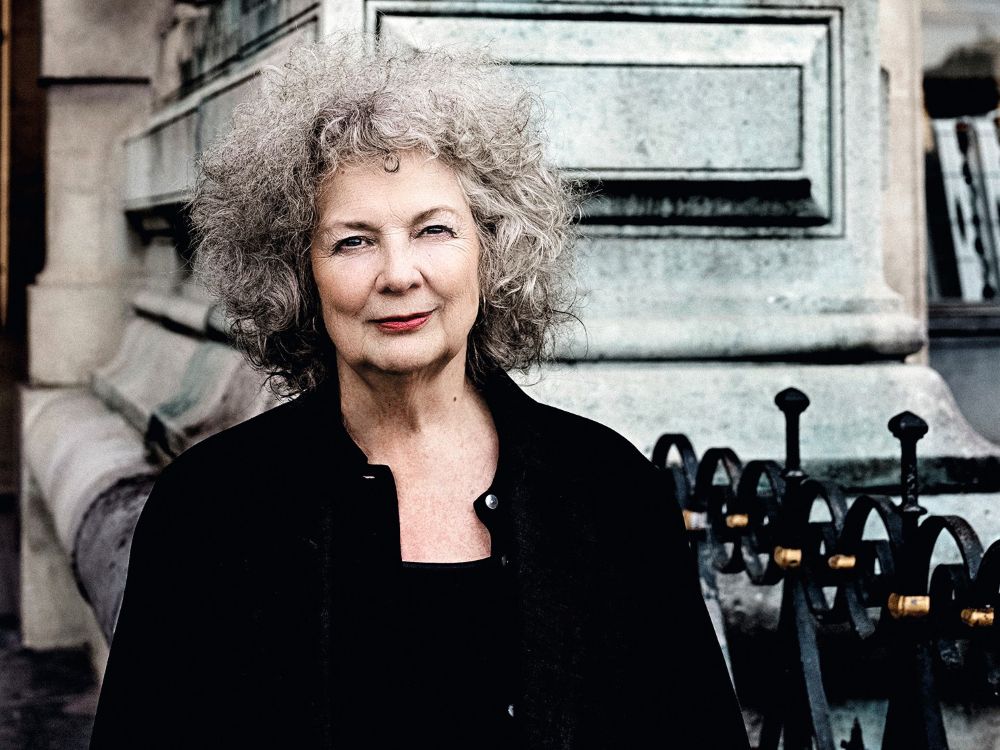
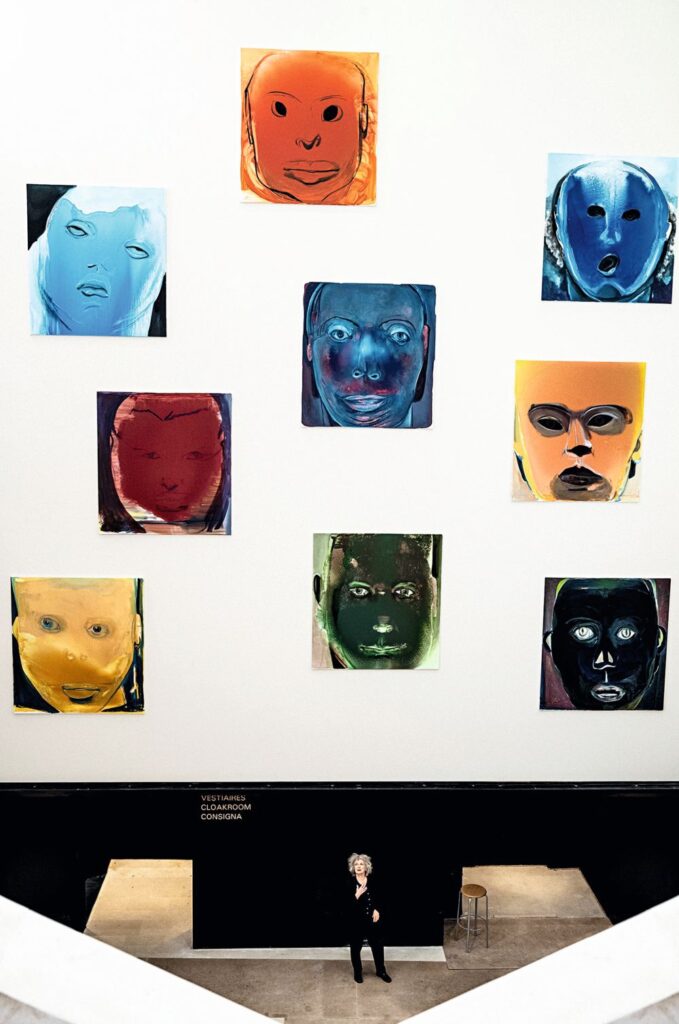
As part of the “Louvre-Nouvelle Renaissance” initiative to promote dialogue between art of the past and present, and between different cultures, president-director Laurence des Cars invited South African-born painter Marlene Dumas to create a new work for permanent installation in the museum. This commission makes her the first living female artist to join the lineage of monumental decors by contemporary male predecessors such as Cy Twombly, Anselm Kiefer, Francois Morrelet, and Joseph Kosuth. Since November 2025, Dumas’s nine-panel work, Liaisons, illuminates the vast wall of the Porte des Lions atrium, threshold to the Gallery of the Five Continents, close to the Department of Paintings and the Grande Galerie. The work includes several references to ancient artefacts in the Louvre.
Art is not a mirror. Art is a translation of that which you do not know.
MARLENE DUMAS
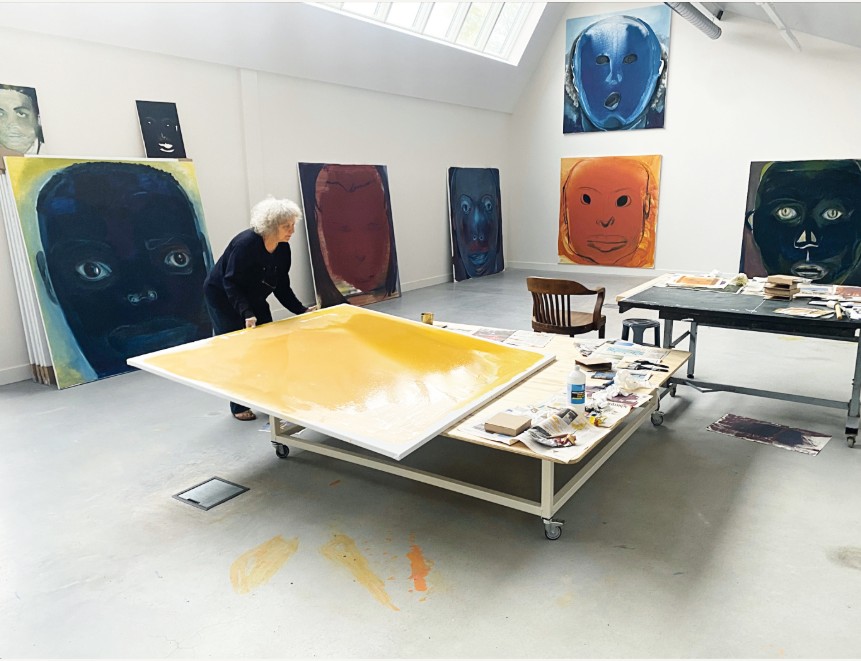
In her formal motivation for this prestigious invitation on the Louvre’s official website, Des Cars stresses Marlene Dumas’s “remarkable virtuosity and technique, both free and precise”. Most critics agree that the power of the work lies in the fact that Dumas has invented a unique “way of doing”. This refers to an experimental method conditioning what might be her most vulnerable painterly desire: that she herself be surprised by the result. The essence of the method is play and risk-taking during events of manual and gestural bewitching of ordinary materials. From the swaths left by initial free, gestural applications, often of watery ink washes or diluted paint, guided by lifting and moving the paper or canvas, the artist selects elements that can be exploited, heightened or adjusted to contribute to a formally satisfying composition.
Apart from wiping down, dabbing and smudging, deft brush strokes – wet on wet, or wet on dry – are added to enter the contours and details. Not only are traces of initial lines retained when they have been finally “corrected”, but “incompletion effects” are also carefully cultivated. A Dumas painting or drawing mostly includes, as a calculated part of its composition, those marks that refer to the improvisational process of its realisation. Each painting and drawing bears indexical signs of the artist’s hand movements – a hand that always “shows” itself in its traces, marks revealing loose, open, expressive strokes and other gestures and manipulations. The opposite approach would be one that seeks to hide the hand in a blended, “licked” finish.
Largely because of this physical treatment of the picture surface, the viewer’s initial reaction to a work is visceral: goosebumps appear, the heart accelerates, the gut stirs, but at the same time the mind is arrested by the titles. Ambiguous and suggestive, they direct and inform but also complicate the gaze.
Dumas’s career thus far is a testimony to an unflinching exploration, not only of the art of painting but also of the abysmal complexities of the human condition. The themes are often weighty, but the process is pleasurable; in her own words, “the how always smiles at the what”. Her work puts a spell on the viewer because it arouses the senses, eludes final interpretation, is “real” in its reference, and personable in its tenor. It speaks of a sensibility that is both tender and quirky, satirical and whimsical, compassionate and humorous.
Marlene Dumas makes a difference by differing stoically from herself, and by importing the tension of this inner alterity into her work – an immense gift of courage to the world.
Dismantling the Face
The qualities of Dumas’s art are best exemplified in what one can call her neo-expressionist “facework”, a trajectory of interventions in which she, as one in a long line of artists from about the end of the 19th century, has challenged the conventions of Western portraiture with its ideological investment in the identity and subjectivity of the sitter via painterly conventions of mimetic representation. She has found her own point of entry in this movement by reinvigorating the 17th century Dutch tradition of the so-called “heads” (tronies), paintings that functioned as models in artists’ workshops, depicting expressive emotions on the faces of “types”. At the time, these could be bought cheaply to decorate living rooms, while the more expensive portraits were hung in the bedrooms.

The nine new face paintings of Liaisons, arranged in a loosely staggered formation on the atrium wall, are the latest iteration of the facial series format that Dumas has produced over the years e.g. Het Hooghuys (1990–1991), Black Drawings (1991–1992), Models (1994), Rejects (1994 – ongoing), Jesus – Serene (1994), Blindfolded (2002), and Great Men (2004 – onwards). These series or assemblages often consist of unframed faces, presented in rows or grids. It is a set-up that collectivises as well as individualises the faces, enabling both similarities and variation in the whole. In her face paintings Dumas mostly refrains from working solely from her imagination as it might cause rehearsing preconceived images according to her usual manner of doing.
As a starting point, she therefore in the main uses photographs of people (or of paintings or sculptures), choosing those that offer exploitable expressions. Under her adage “one takes a photograph, one makes a painting”, she ambiguates the face in the photographic version, relying on the unpredictable and only partly controlled effects of her technique to discover and trap micro-expressions as they hover and fade around the eyes and mouth.
Rather than representing individuals, it is the psychological drama of “what happens between them” that concerns the artist in her more portrait-like faces. But the narrative situation between two people, with only one of them present in the face paintings, sometimes “dissolves” into “presence”, and the viewers, with no interpretations to hold on to, are “back in the courtroom”, left to face the work as an irreducible and sovereign artistic object. Subjected to its “interrogation”, they must find their own answers.
How are we to “account to” the enigmatic, intimidating “presences” that make up Liaisons? Are we confronting a jury? May we, considering the title, ask what dangerous, illicit and intimate relations they entertain and with whom? Or do they “liaise” in the sense of communicating as representatives? But with whom?
In an interview with Donatien Grau to coincide with the opening of the exhibition of Liaisons, Dumas remarked that she painted the new work in the shadow of the current genocidal wars, thinking of the people forced to flee from these catastrophes, only to arrive in foreign countries where they are branded as aliens.
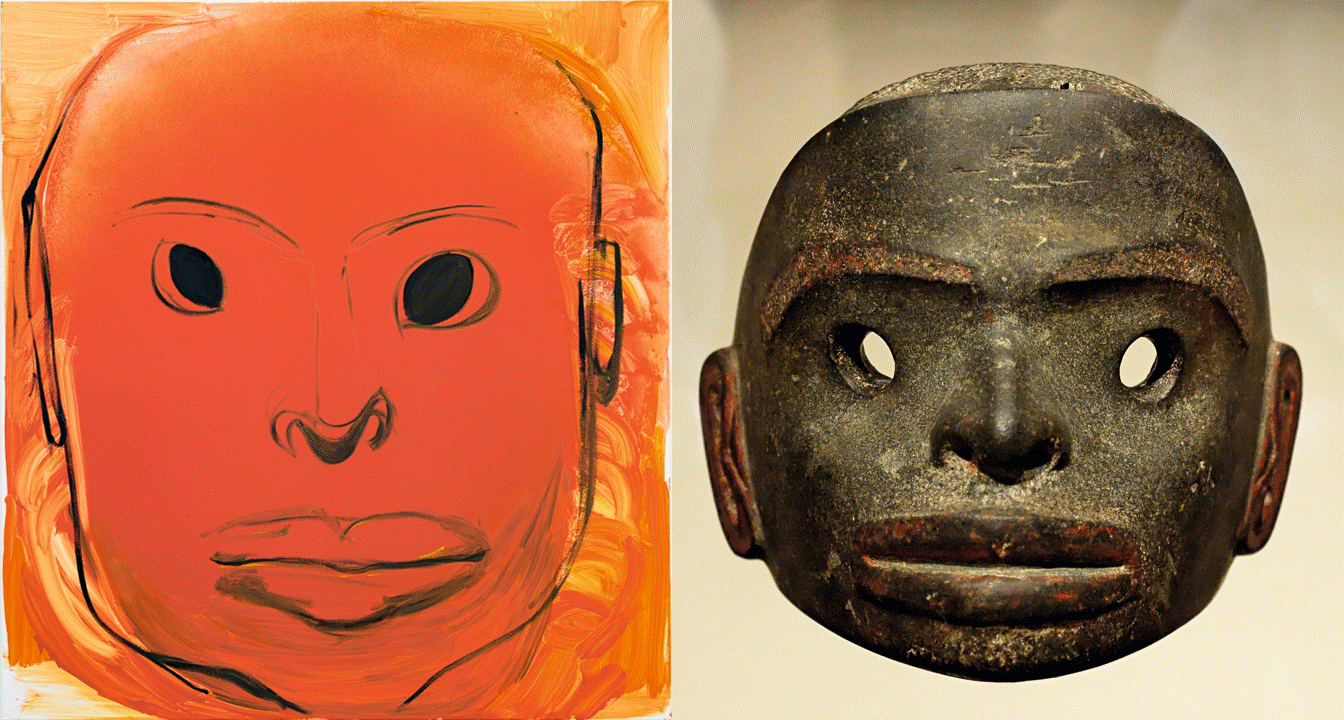
From the painter’s self-description, marked by an enduring existentialist sense of alienation in the present era, one might surmise that Liaisons also carries an echo of violent forms of Western colonial expansion, during which many of the artefacts in the Gallery of the Five Continents were “collected”, often appropriated, from premodern societies where they once fulfilled specific ritualistic functions. One could suggest that the artist’s faces in the atrium might “liaise” with these isolated pieces in the museum’s glass cases to form an odd team of alien presences linking social contexts of the past and the present.
Of the nine paintings, two had ancient artefacts as sources: a Philippine carving, source for Ceramic Silence and a North Canadian mask for Vermillion Heat. What they share with the other seven faces is indetermination. The expressions on all these faces leave us baffled; none are clearly identifiable in terms of race or gender; they seem to belong to a new tribe, “a community of those who have nothing in common”, to quote Alphonse Lingis out of context.
They are faces only by the skin of their teeth; in their unmoulded “flat” monumentality they are more like facades. Through their intense colour, they refer to the elements (air, fire, water, and earth), as the painter suggests. One also thinks of the nine Muses of Greek antiquity or of the Egyptian Ennead.
The vibrant tints, sometimes applied in half-transparent, glowing layers, are to a greater or lesser degree “facialised” by cursory renderings of mouths, eyes and noses. Similarities and variations are carefully modulated across the panels; some of the heads, for instance, fit in just below the top edge of the canvas, others are “broken” or “leaking” or seem “flooded by light”. Some of the foreheads seem to extend beyond the edge of the picture plane, suggesting a “head burst” of enlightenment or mystical rapture.
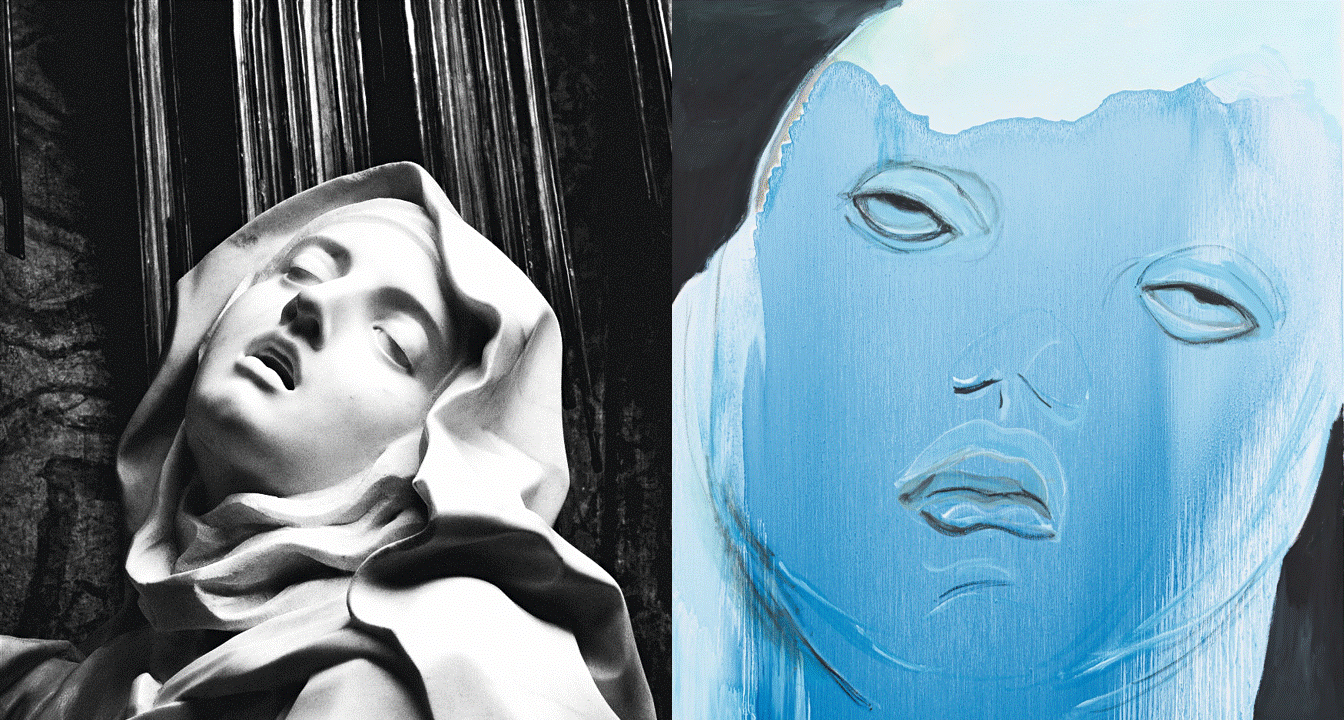
The eyes of some faces peer vaguely from behind stark black holes as from behind masks, the lips of others smile vaguely, while the expressions in most of the more fully rendered pairs of eyes are unfathomable. One rolls her eyes upwards in a swoon, like Saint Teresa in Bernini’s famous sculpture, while another has vertical slit pupils, and has been dubbed Snake Eyes in the subtitle supplied by the artist.
The latter’s face arose purely from the imagination, quite the exception in Dumas’s face painting oeuvre, while the absence of a nose in the face of Split Stone was initially suggested by the broken edge between two tints of apricot colour and only later linked to a memory of ancient, damaged stone sculptures.
The process involving source material could therefore be reversed, as also in Alaha’s Light, where the initial layer of orange paint formed the starting point. The painter’s quest for a suitable image that would facilitate the addition of facial features led to the discovery of an Egyptian royal head from the 11th millennium BC. Painting could precede the source, and more painting could follow.
According to Dumas, art works are like unfaithful lovers and will betray not only their creator but all previous interpreters if a viewer with a more attractive interpretation comes along.

The humour of this remark is self-directed, for it is nobody but the artist herself who has consciously cultivated the ambiguity of the work. It ends up being poly-interpretable to such a degree that endless exegesis and reams of ekphrastic (vividly descriptive) art historical and literary writing will ensue. The wordplay is continued in her self-given nickname, Miss Interpreted. We are often reminded by the artist that the point of the paintings is the paintings as paintings, not their “deeper” meanings. But she also pertinently asks: what is a good painting without a serious subject?
Here it is worth remembering, with Wallace Stevens, that if the subject is a blackbird, there are thirteen ways of looking at it. When we look from a distance, the expressions on these faces intrigue us, but then they call us to come closer and enter into the open fields of colour, inviting us to inspect their “skins”– reminiscent of water over stones, moss on fallen trees, rust, patina, lichen, oil, translucent amber, reflections in glass – so that we lose our orientation on the map of the facial features. In our oscillation between, on the one hand the visages and their “looks”, and on the other hand the lure of their abstractly treated superficies, the painter succeeds in mesmerising us. We cannot tear ourselves away; we step up and we step back and step up again. A dance. The painter has moved us.
Let us give Oscar Wilde the last say: “All art is at once surface and symbol. Those who go beneath the surface do so at their peril. Those who read the symbol do so at their peril. It is the spectator, and not life, that art really mirrors.” V
Acknowledgements: Thank you to Marlene Dumas for wonderful hours of conversation in her Amstelveen studio, and for all the insights, ideas, sources, and materials she generously plied me with, also to Willem ter Velde, who manages the Dumas archive, for his professional support, and to my partner, Henda Strydom, who lovingly accompanied the process of research and writing.
Artist’s quotes: From Sweet Nothings, Uitgeverij De Balie, Amsterdam, 1998, and from her writings on the website marlenedumas.nl.