

At a time when many schools are questioning the use of tech, one Stellenbosch campus is harnessing it to reimagine how we teach, writes JENNI DAVIES.

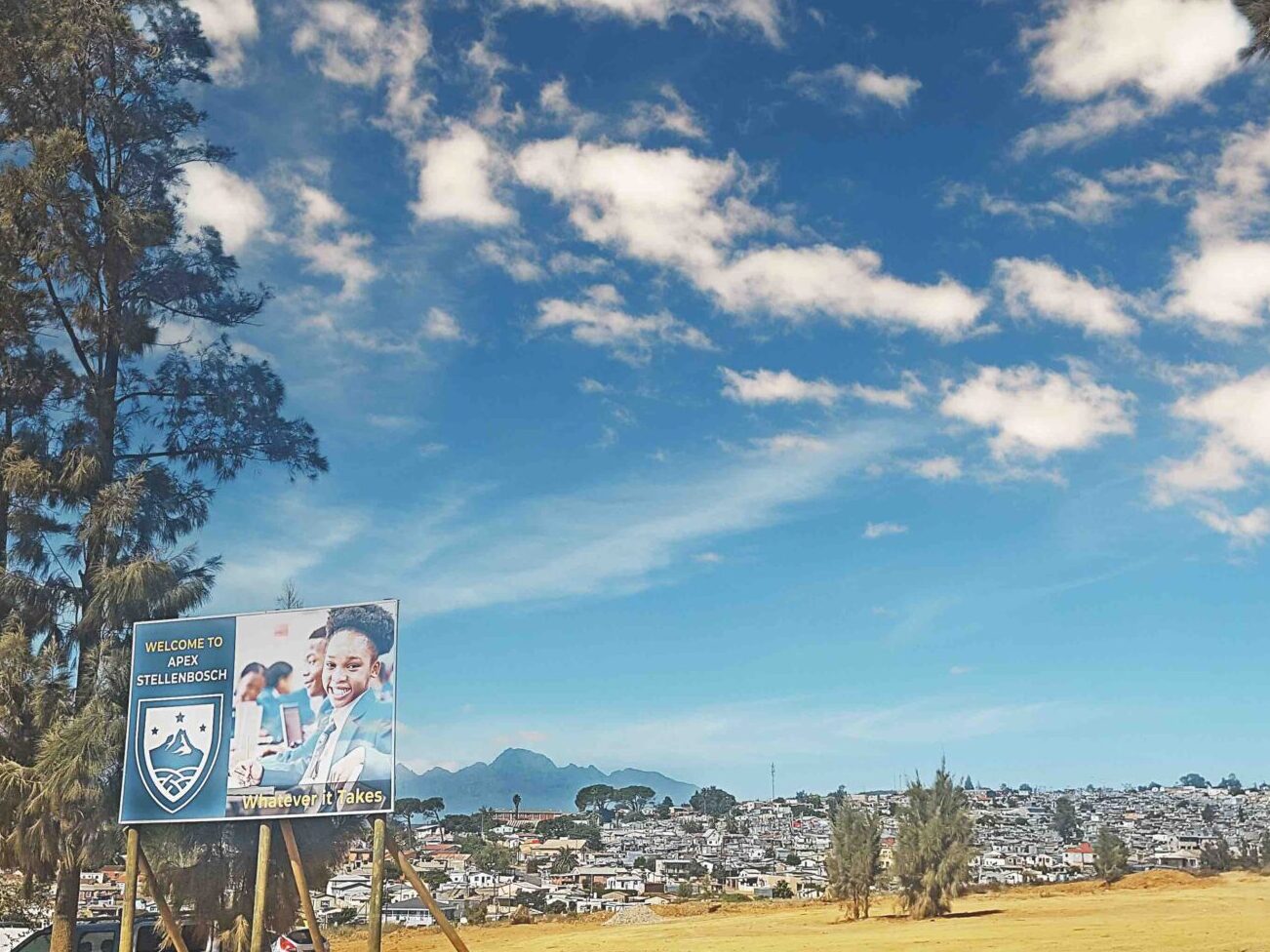
The entrance way to Apex Stellenbosch, just off the busy Koelenhof Road, isn’t what you’d expect – at least, not yet. It’s a construction site in action; trucks rumble past, cranes groan, dust lifts into the blue morning sky. And then, through the pines, an unexpected view opens.
In front, the vibrant, bustling community of Kayamandi. Behind, the hazy, familiar line of the Stellenbosch mountains. And between them, an innovative blended-learning school. It’s built in what was once a wine cellar – the past repurposed into something new.
Inside, it’s an oasis of order amid the non-stop movement around it. Bright, clean, filled with light. A large photograph of proudly smiling children in bright blue uniforms draws your eye. The sense of pride is clear.
But the story behind this remarkable school doesn’t begin here.
ANSWERING THE BIG QUESTION
It begins, explains Jana du Plooy, founding CEO of Apex Education, with a seemingly simple question: how do you make the high-quality education every child deserves accessible in a resource-constrained system? The organisation had already seen great success at a no-fee high school it had started in Eersterivier, in collaboration with the
Western Cape Education Department. But that success brought pressure as demand swiftly grew, while resources did not. And then the pandemic hit.
“Like other schools, we started teaching virtually. But what we discovered surprised us. Many children, whether they were at home learning online or whether they were physically at school, still performed consistently.”
When most schools returned to ‘normal’, Apex took stock of what had worked and what hadn’t. “With the traditional in-person model, you need more space, more teachers … and more money,” says Jana. “But much of a teacher’s time isn’t spent on teaching – it’s admin, marking, behaviour management. Every time you add more children, you need more teachers and classrooms – increasing the costs but not necessarily improving the learning experience.”
THINKING BIG WITH BLENDED LEARNING
The answer was rethinking how classrooms work around teachers – with integrated blended learning. Combining face-to-face teaching and online or digital activities like this isn’t new. Most schools use it in some form.
“Our model,” emphasises Jana, “had to be very intentional – the role of teachers, the design of the classes, the use of facilitators, the way the lesson is delivered, how the children learn. The technology isn’t an add-on; it’s embedded. But to keep innovating and expanding, we needed a place to strike out on our own. Stellenbosch became that place. Kayamandi – one of the first townships in South Africa with widespread fibre connectivity – was a natural fit.”
With support from private donors, the land alongside Kayamandi was purchased and, in 2024, Apex Education’s first low-fee private high school opened its doors to a group of Grade 8s.
It’s projected to be at its full capacity of 1 800 children within two years. And, with a goal of serving 10 000 children across South Africa annually within 10 years, this school in Stellenbosch is set to be the blueprint for many more.
STEPPING INSIDE THE CLASSROOMS
A space with so many children and the distraction of screens could feel chaotic. On the other hand, they could be overly controlled – numbers in a system. It doesn’t take long to realise it’s neither.
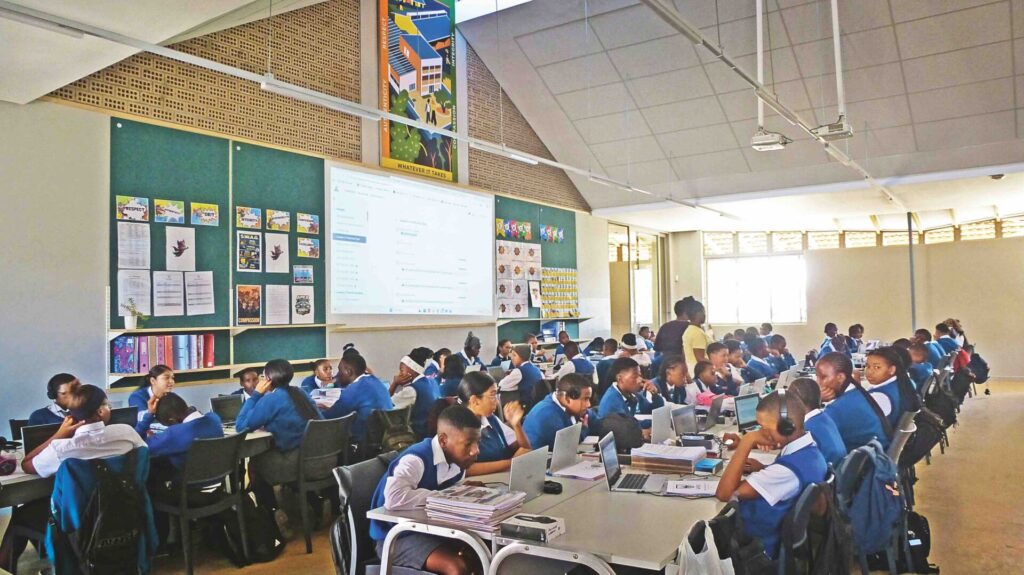
That’s where Sanrie van der Westhuizen, the head of blended learning, comes in. “At Apex Stellenbosch, there are three adults to 100 children,” she explains as we walk through the tidy school grounds with their views of Kayamandi and the mountains. “One teacher and two trained facilitators, all underpinned by technology.”
Although 100 learners may sound like chaos, it’s anything but. I’m struck by the spacious, light-filled classrooms, the buzz of young people engaged in their tasks. Bright blue blazers hang from chairs. Books share desk space with laptops and headphones. Adults calmly move through the room, ready to step in when needed.
DESIGNED WITH INTENTION
Sanrie explains that Apex has built its own online platform, with more than 4 000 lessons tailored for South African children.
“We didn’t just take anything we found online. Lessons should reflect the children we serve, not international content. They are designed by teachers around the country, standardised so that every child gets the same quality as a starting point.”
A printed workbook accompanies online work, both to practise the skill of writing and for learners to work at home even if they have no access to electricity or computers. It’s an approach that reflects the deep understanding of the community for whom the school is working.
But the difference isn’t the content. “For us, the learning is data-driven, allowing for responsive teaching,” says Sanrie. Each lesson contains several check-in points and quizzes, which are continuously monitored by teachers via the system’s dashboard. Any challenges are addressed immediately. “Every single day is an intervention day.”
Sanrie emphasises that this isn’t about keeping teachers out of the loop; far from it. It’s about empowering them by freeing up time to actually teach. “Instead of marking 100 scripts or handing out papers, they can focus on connecting with learners. On educating and guiding them to success. That’s what we’re all here for.”
Jana is clear: their work doesn’t stop at their schools. “We exist to improve education for every child in South Africa, so we cannot gate-keep knowledge,” she says. “What we learn here, we’ll make available for free. If we have extra resources, we’ll share them. This isn’t about ‘intellectual property’; it’s about educating children.”
CLASSROOM CULTURE COMES FIRST
But education is about more than just lessons on a laptop. “You can’t take a dysfunctional school and think learning’s going to take place just by adding technology,” cautions Sanrie. “We work very hard on school culture and good values, and teaching the learners about having a growth mindset – and reflecting it ourselves.”
This is a culture rooted in the seemingly small things: structure, punctuality, respect for the space, pride in wearing school uniforms,
addressing each other with kindness and respect. Everything contributes to an environment that fosters learning – and helps to form people who will carry this culture into the world.
Apex learners are now outperforming provincial averages in both language and maths. Not because only high-achieving children are accepted – any child living close by can join – but because the blend of tech and the human touch is allowing the school to close the gap that makes equitable education so difficult. And the success is starting to attract attention beyond South Africa’s borders, as Apex is being approached by educators from as far away as South America and Singapore who are looking to Stellenbosch for a blueprint.
A PLACE OF BELONGING
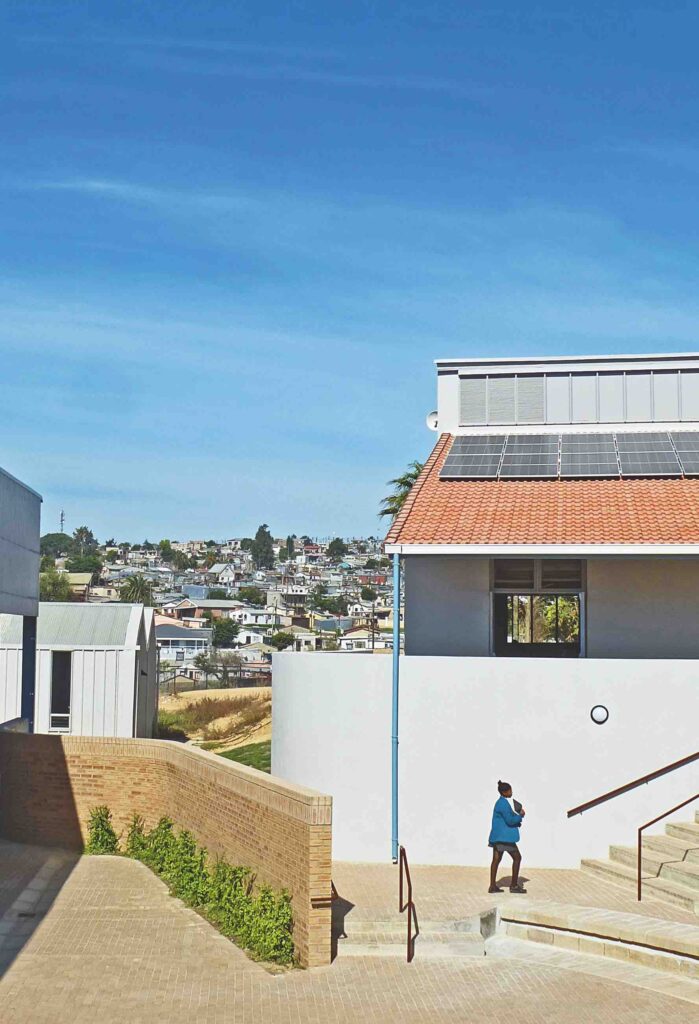
It’s all happening here, alongside Kayamandi – meaning ‘sweet home’ – a thriving community that’s been part of Stellenbosch since the 1930s. It’s framed by the school’s buildings, visible from the classrooms. Many staff members are local. The property is planted with indigenous plants and saplings. Rather than turning its back on the community, the school is part of it.
“From the municipality right through to the Kayamandi community and people of Stellenbosch, it’s clear that a lot of good people care deeply about what happens to the kids,” says Sanrie. “They want them to excel and are willing to support that. We even have private donors sponsoring children or contributing towards the school.”
What stays with me is not the technology or even the model. It’s the children – engaged and fully immersed in their work – the bright classrooms, the focused teachers. It’s also the balance between technology and humanity, structure and flexibility, past and future.
As I leave, the construction site no longer feels out of place; it feels like part of the picture. The bumpy road is less like a detour and more of a link. Kayamandi and the mountains are part of the same frame. And, in the midst it all, the school just fits.