

One of the best ways to see the French countryside is to hire a boat. This leisurely way of travelling takes you through beautiful scenery and you don’t even need a skipper’s licence. By MAGRIET KRUGER
What was the highlight of our river holiday in France? It could be sitting on the deck with a glass of wine and looking out over medieval town walls as the sunset painted the sky. Or waking to a picture of that town perfectly reflected in the placid water, then taking a wander to find croissants for breakfast. Or simply how one picturesque scene after another unspooled before us as we puttered along the river. Rolling fields of wheat, a chateau on a hill, avenues of plane trees by the water’s edge. Really, it was all this and more.
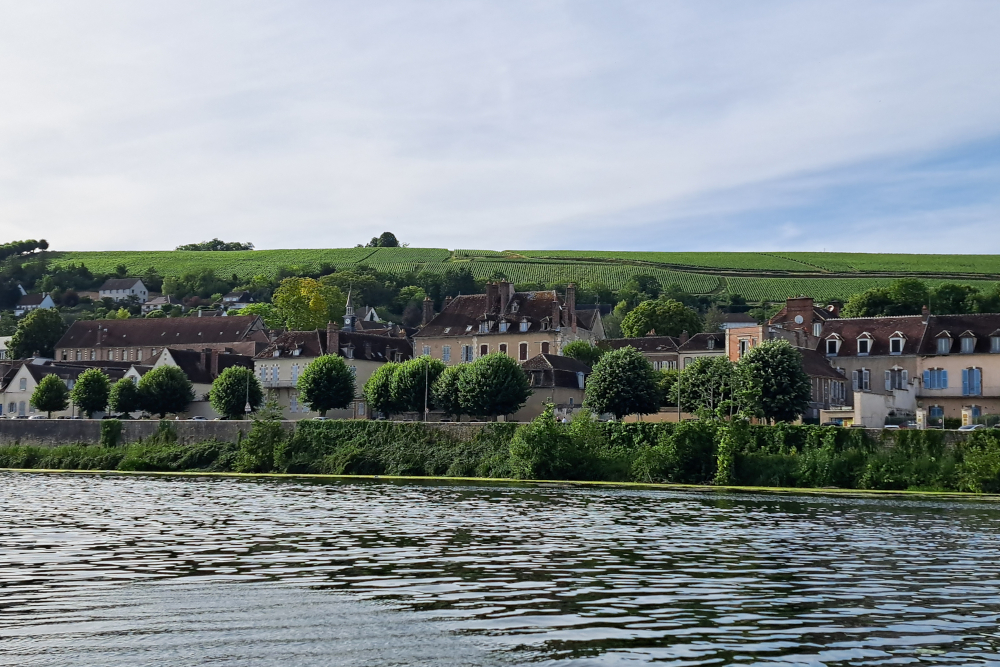
Our boating holiday on the Yonne River in the Burgundy region of France was many decades in the making. I was still in primary school – my parents younger than I am now – when we first began to dream about a holiday on the waterways of France. Other destinations took priority in the years that followed, but the delay brought its own advantages. The typical barges made way for more modern boats that are roomy, comfortably equipped and can be steered without a special permit. At the beginning of the European summer, four of us – my parents (both in their 70s), my husband and I – flew to Paris and took an hour-and-a-half train ride to Migennes to embark on our boating adventure.
BOATING IN BURGUNDY
After poring over maps, guides and books on France, my dad had selected the stretch of the Yonne between Migennes and Sens for our trip. The river wends its way through Chablis country and we could expect to meander past vineyards and quaint villages. We’d been tempted by Auxerre, a tourist town further south on the river, known for its grand cathedral and vibrant timbered houses. But we wanted to take a slower pace and not contend with masses of tourists. It proved the right choice for us as the river was quieter and we never had to queue to gain entry to a lock.
We rented a four-sleeper Corvette from Le Boat, with a cabin fore and aft, each with its own en-suite bathroom. In the middle, a lounge where we could unwind and have meals, along with a galley kitchen with full-size gas stove. Fitting under the kitchen counter, the fridge was compact but ample enough for the purposes of our trip. After all, part of the pleasure of touring France was to regularly visit markets for fresh produce, meats and cheese. On the deck there was more seating next to the steering position, as well as space for an outdoor table and chairs.

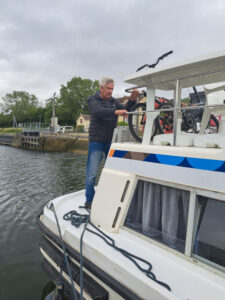
Our trip began with an orientation session as a technician showed us how to start the boat, move forwards and backwards, and execute basic manoeuvres. You don’t need a skipper’s licence to steer these flat-bottomed boats – you learn by doing. We watched how other travellers handled things and picked up tips along the way. There is a great sense of camaraderie on the waterways of France. Other boats would help us tie up next to them in locks and, at mooring points, someone often appeared to lend a hand with the ropes. One gentlemanly French captain gave us tokens to get free water and electricity in the town of Sens.
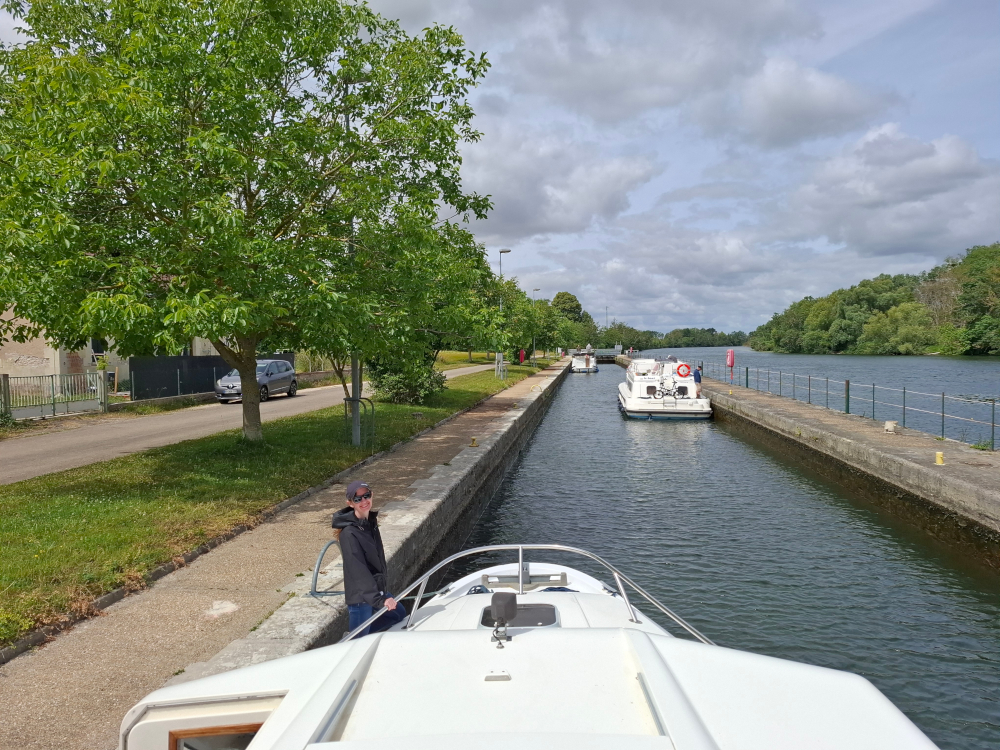
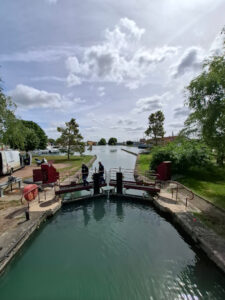
At the locks we all got involved in tying the boat up and my parents showed they could cast a rope and haul in a boat when needed. We got to know the lock keepers, who ranged from well-muscled young men to operators who have weathered many seasons to thirty-something women with tastefully painted nails. Although most of the locks on our route were automatic, at some we would watch the keeper walk back and forth between the gates to adjust levers. I never grew tired of watching the ingenious engineering and the masses of water that poured in or out to help us reach the right level.
EXPLORING TOWNS ALONG THE RIVER YONNE
Our first stop, Joigny, was exactly what I had imagined a river town to be: pastel-coloured buildings climbed a gentle hill topped by a church. A patchwork of green vineyards and golden wheat fields covered the surrounding slopes. Because river traffic used to be the lifeblood of these towns, they are oriented towards the water and our mooring point was usually right by the entrance to the historic centre. In Joigny, we simply crossed the bridge to enter the main shopping street. Joigny’s main church is a Gothic construction with a copper-roofed bell tower that has turned an attractive shade of verdigris.
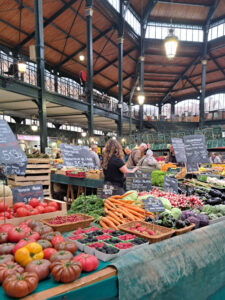
Our visit to Joigny coincided with market day and what a treat! Sun-ripened tomatoes in varying shades, shapes and sizes. Artichoke globes nearly as big as melons. Crisp green beans, shiny red peppers and vivid small radishes. At the cheese stall we couldn’t even identify half the cheeses on offer. We selected freshly baked quiches from the baker to complement our haul of oxheart tomatoes and white asparagus.
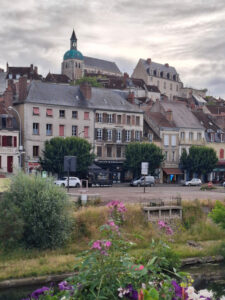
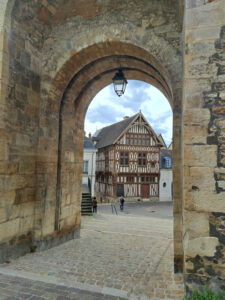
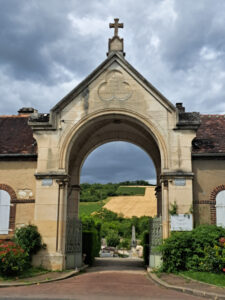
The medieval town of Villeneuve-sur-Yonne was the smallest of the places we stopped at and rather sleepy since our trip was ahead of the summer school holidays. We enjoyed our visit to Maison Dosnon, where the local honey has been turned into delectable products for over a century. This region is famous for its gingerbread and there was a wide variety of flavours, but the beer with a touch of honey was what caught our eye. Villeneuve-sur-Yonne’s turreted town gates are worth admiring and a short bike ride brought us to a lake with dozens of white swans.

Once the capital of the Senones, a tribe that fought wars against the Romans and won, Sens has a rich history. In the archbishop’s palace next to the Cathedral of St Etienne, an excellent museum traces the city’s development. We marvelled at an elaborate Roman mosaic floor and delicately designed cloak pins from the Bronze Age. There are priceless religious items from the Cathedral Treasury, as well as Napoleon’s hat and uniform jacket. A highlight was the art gallery, with two original bronzes by Rodin and several pieces by Dutch and Flemish masters.
The light-filled Sens cathedral, which dates to the 12th century, is considered the country’s first great Gothic cathedral – the master builder subsequently worked on Canterbury Cathedral. A sign of the town’s importance is that the cathedral is the last resting place of the parents of Louis the XVI – their elaborate marble tomb escaped destruction during the French Revolution. At the time of our visit, an organist was practising and the sound floated up to the cathedral’s vaulted ceiling. Sens also has a large covered market where you can buy fresh produce and regional delicacies, including garlic snails if you want the full French experience.


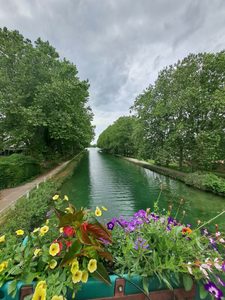
We quickly settled into life on the boat: finding the local baker for pastries in the morning, drinking in the surrounds as we meandered along the river, spending the long evenings on the deck with a bottle of wine. Our route featured only one stretch of canal, between Joigny and Etigny: tranquil and dreamy, the water mirroring the puffy white clouds above. But I relished the wilder river with its cormorants diving for fish and jewel-coloured dragonflies darting between the reeds.
On the last day, after we had tied off the boat for the final time, we took our bikes along the canal that stretched in the other direction from Migennes. Lined with trees, the towpath was cool despite the afternoon’s heat. Among a patch of waterweeds, my husband saw a flash of brown: an otter. We watched as it dived and fed, a scene unchanged by centuries. The perfect end to our French waterway adventure.
Good to know
You can rent your houseboat from Le Boat or Riverly, from basic boats to luxurious crafts, sleeping 2-12, depending on your needs.